28 Jun 2026
The Palette Architects: Color Consultants Crafting Mood in Global Arthouse Cinema

Color consultants have played a central role in shaping the visual identities of international arthouse productions since the mid-20th century, and their methods continue to evolve as digital tools expand creative options. These specialists analyze scripts, collaborate with directors and cinematographers, and select palettes that align with narrative themes while supporting the emotional tone of each scene. Research from film studies programs at institutions such as the University of Melbourne indicates that coordinated color strategies appear consistently across acclaimed works from Europe, Asia, and Latin America.
Early examples emerged in the 1960s when European directors sought to differentiate their projects from mainstream studio output. Consultants helped establish desaturated tones in French New Wave films and cooler hues in Scandinavian dramas, creating atmospheres that reflected character psychology without relying solely on dialogue. Observers note that these choices often required testing multiple film stocks and lighting setups on location, which added logistical layers to already tight independent budgets.
Methods Behind Palette Selection
Consultants begin with script breakdowns that identify key emotional beats, then map corresponding color families using reference boards and digital previews. They coordinate with production designers to ensure set dressings, costumes, and practical lighting reinforce the intended mood rather than compete with it. Data from industry reports compiled by the European Audiovisual Observatory shows that arthouse projects employing dedicated color consultants complete post-production color grading 15 to 20 percent faster on average because early decisions reduce the need for extensive corrections later.
Techniques range from strict limited palettes, as seen in certain Japanese and Korean art films, to more fluid transitions that mirror seasonal or psychological shifts within a story. Consultants frequently conduct on-set tests with stand-ins and sample lighting to verify how colors render under specific conditions, adjusting for regional variations in natural light and available equipment.
Regional Approaches Across Decades
Practices differ by region and era. In Latin American productions of the 1980s and 1990s, consultants often incorporated local pigments and textiles to ground stories in cultural specificity while maintaining artistic cohesion. Asian arthouse directors have leaned on consultants to balance vibrant market traditions with minimalist compositions, resulting in palettes that evoke memory and restraint simultaneously.
Recent projects scheduled for festival premieres in June 2026 continue this pattern, with several titles from Eastern Europe and the Middle East featuring consultants who integrate both analog film tests and digital LUT development. These efforts support the distinct visual languages that arthouse audiences have come to expect from international cinema circuits.
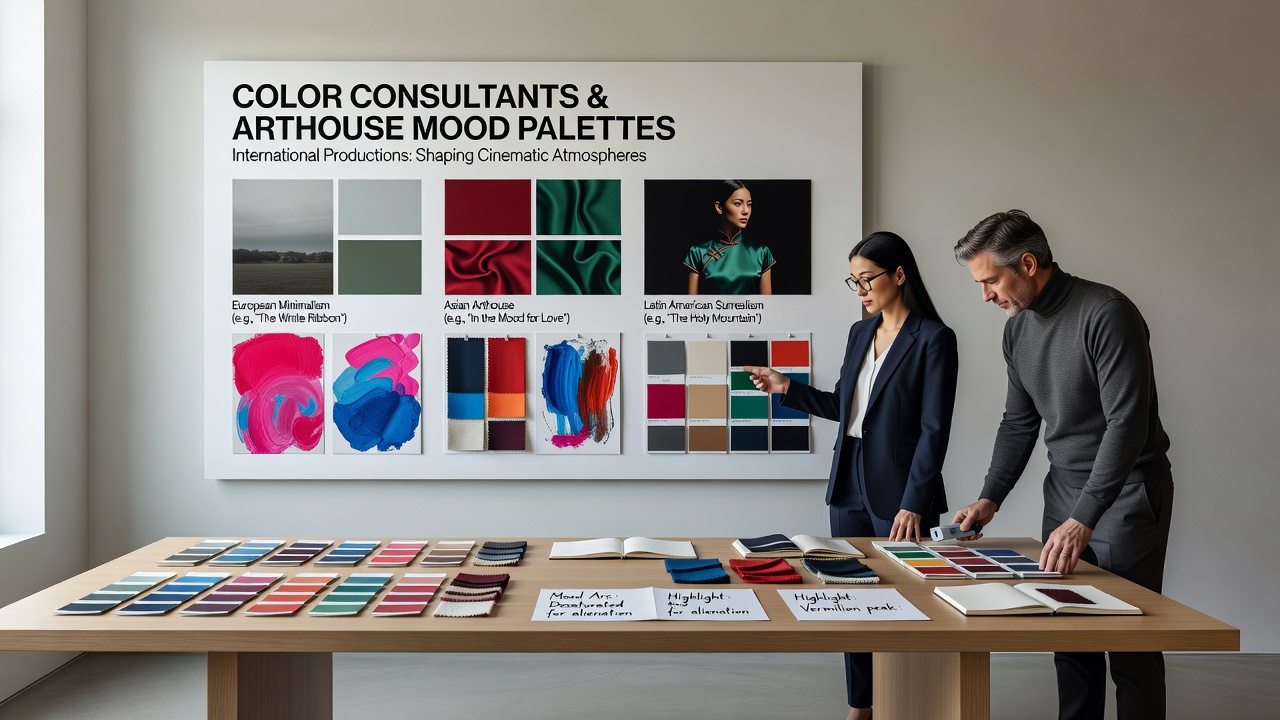
Training pathways for color consultants typically combine formal education in fine arts or film production with apprenticeships under established cinematographers. Professional organizations such as the Society of Motion Picture and Television Engineers have documented how certification programs now include modules on mood-specific palette construction, reflecting demand from independent producers worldwide. Those who complete such training often report that the most challenging assignments involve maintaining consistency across mixed lighting sources and international co-production crews.
Impact on Audience Perception and Festival Circuits
Studies conducted by Canadian university researchers tracking viewer responses at major festivals demonstrate measurable differences in emotional engagement when color palettes receive dedicated consultation. Participants exposed to intentionally modulated hues reported stronger recall of thematic elements compared with control groups viewing standard-graded versions. These findings align with patterns observed in festival programming, where visually distinctive titles frequently secure wider distribution deals.
Co-productions present additional considerations because consultants must reconcile differing cultural associations with certain colors while preserving a unified visual identity. Teams address this through iterative reviews that incorporate feedback from all partner regions, ensuring final deliverables meet both artistic goals and technical standards for multiple markets.
Conclusion
Color consultants remain integral to the visual storytelling strategies of international arthouse productions, bridging creative vision and technical execution across diverse cultural contexts. Their contributions appear in both historical landmarks and contemporary festival selections, supported by evolving training standards and collaborative workflows. As production technologies advance, the core task of aligning palette choices with narrative mood continues to define their ongoing role in global independent cinema.